
Clifton Park Previous Residents by Era
Different sources cover different stretches of time, and none is a complete occupancy list. The deed trail crosses Town of Clifton Park, Saratoga County, New York, and national custodians. Census, directories, newspapers, and cemetery records can add people associated with an address. The table separates recorded coverage from an unsupported assumption. A transfer of property is evidence of an interest in land, not proof that the new owner lived there.
| Source | Years it covers | Where held | What it can show |
|---|---|---|---|
| Deed index and images | 1791 to present; data and images from December 1987, older index books from 1791 through November 1987 | SearchIQS and Saratoga County Clerk public computers or counter | Grantor, grantee, recording placement, legal description, and image when available |
| County map series | 1765 to present in series; data and images from 2009, older index books before that | SearchIQS, Real Property, GIS, and office-only historical maps | Lots, surveys, subdivisions, and tax-map continuity |
| Municipal assessments | 1889 to 1914 at the County Historian; later records with municipal assessors | County Historian and Town of Clifton Park Assessor | Owner, assessment, and sometimes a description or mailing location |
| New York State census | 1855, 1865, 1875, 1892, 1905, 1915, and 1925 | CPHPL microfilm, County Historian, and library databases | Household members and road or address context at the census date |
| Federal census | 1790 to 1950 publicly available under the release rule | National Archives, FamilySearch, and library resources | Household, age, relationship, and enumerator district |
| Directories and newspapers | Exact Clifton Park directory and CPHPL newspaper runs were not verified | CPHPL reference route, Library of Congress, clipping files, and news databases | Irregular name, address, occupation, and notice clues |
| Citizenserve permits and planning activity | Online history cutoff was not published | Town portal and Planning, Zoning, or Building office | Address, applicant or owner, project, plans, review, and inspection dates |
| Cemetery records | Years vary by cemetery | County Historian, Town historic map, and library | Burial, date, and plot clues for a deceased person |
For recent history, begin with the parcel and the deed reference. For a nineteenth-century question, first decide whether the older index books, historical maps, assessment bridge, or census has the best chance of carrying the address backward. Note: The date span of a record series does not guarantee a complete result for every Clifton Park address.
Start a Clifton Park Previous-Resident Parcel Trail
The backward trail starts with the current parcel, not with an assumed past resident. GAR PROS can return the current and prior owner, owner mailing fields, situs address, SBL, sale or deed date, book and page, map references, and building characteristics. An SBL is the section-block-lot identifier used to keep a parcel straight when a road name or house number has changed. The mailing address and the situs, or physical property address, can differ.
Write down the result before moving on. A parcel split, subdivision, condominium, or lot-line change can make an address look continuous when its legal description is not. The deed book or page shown in the property result is a lead into the Clerk’s records, not a substitute for the deed image. Check the Saratoga County Map Viewer when the parcel boundary or road context needs a second check.
- Search the address or SBL and confirm the Town of Clifton Park result.
- Record the property location, current and prior owner fields, deed date, book and page, map reference, and legal description when shown.
- Compare the parcel in the county map viewer if the road crosses a subdivision, hamlet, or tax-map section.
- Use the owner’s recorded purchase as the first deed-chain link, then preserve the SBL and legal-description notes for every older step.
Clifton Park Previous-Resident Deed Cutoffs
Saratoga County land records reach to 1791, but the delivery method changes with the era. SearchIQS lists modern deed and mortgage index data and images from December 1987 onward. Deeds and mortgages from 1791 through November 1987 are represented through older index books and related material. A blank modern-style search is therefore not a reason to end a Clifton Park house-history search. It may signal that the next step is a scanned book or the County Clerk’s public terminal.
The Saratoga County Clerk offers online account creation, public computers and research access at 40 McMaster Street in Ballston Spa, and copy-request channels. Research hours are listed as 9 a.m. to 5 p.m.; land recordings and court filings have a separate 9 a.m. to 4:15 p.m. schedule. The Clerk’s FAQ describes mailed deed-copy requests with payment and a self-addressed stamped envelope. These channels matter when an index page lacks the image or an older book needs careful browsing.
The SearchIQS coverage table distinguishes current data-and-image records from the historical index-book period.
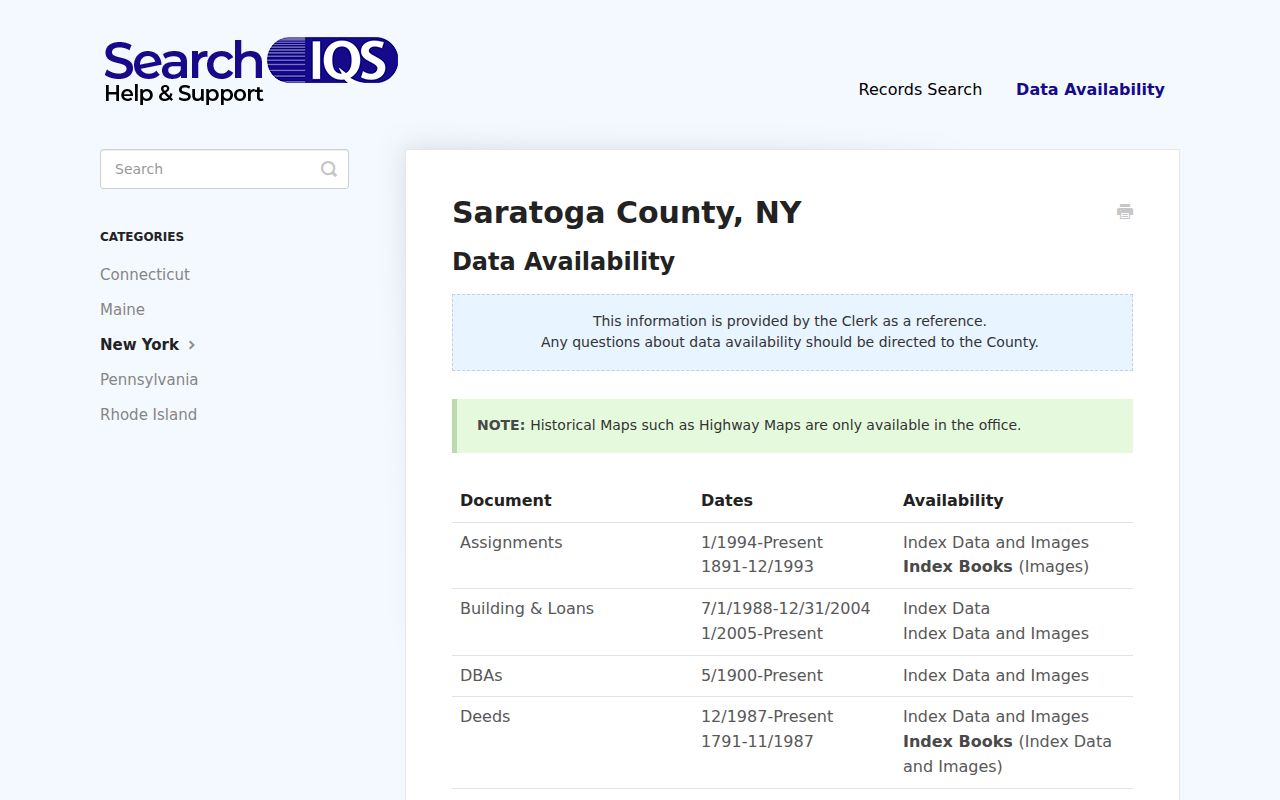
The mixed system preserves a long Clifton Park deed trail, but it requires a different search method before and after the modern imaging cutoff.
Clifton Park Deeds for Previous Residents
Use the parcel result to enter the deed chain backward. Find the current owner as the grantee, the person who received an interest, and retrieve that purchase deed. The seller is the grantor, the person who conveyed the interest. Search that seller as a grantee to find the earlier purchase, then repeat. At each handoff, compare the SBL, legal description, and map or lot reference. The name alone is not enough.
- Open the current property result and save the SBL, deed date, book and page, prior owner, and situs.
- Locate the current owner’s purchase in the Saratoga County Clerk / SearchIQS deed index or by the recorded reference.
- Read the purchase deed for the grantor, instrument details, legal description, and map or lot reference.
- Search that grantor as a grantee for the earlier acquisition, then test the parcel identifiers before accepting the link.
- Move to older SearchIQS index books or the Clerk’s public terminal when the chain reaches the pre-December-1987 period.
- Grantor / grantee
- The grantor conveys an interest in property; the grantee receives that interest.
- Chain of title
- The sequence of recorded transfers used to connect one owner interest to an earlier one.
- Legal description
- The lot, tract, subdivision, or metes-and-bounds description that identifies the land more reliably than a changing street address.
- SBL
- The section-block-lot parcel identifier used in tax and assessment records to distinguish one property from another.
Clifton Park Previous-Resident Assessment Bridge
The County Historian’s municipal assessment records provide a particularly useful bridge from 1889 to 1914. Later assessment material belongs with municipal assessors, including the Town of Clifton Park Assessor. Assessment records can connect an owner, value, description, or mailing location to a period between deeds and census dates. They should be read alongside the deed chain, since an assessment entry does not independently prove that every named person occupied the address.
This division of custody is a local records fact, not a general rule. The Historian also holds map, cemetery, census, town-file, surname, and family-Bible material, so one appointment can test several parts of a hard address trail. The 1889 to 1914 bridge is especially helpful when a deed identifies a parcel but a household remains unclear. Note: Later assessment records should be requested from the appropriate municipal assessor rather than assumed to remain at the County Historian.
Clifton Park Previous Residents in Census
Deeds trace recorded interests. Census schedules help identify a household at a point in time. Pair a confirmed parcel or road clue with the closest New York State census and federal census. The state snapshots for Saratoga County are 1855, 1865, 1875, 1892, 1905, 1915, and 1925. Federal schedules available to the public reach 1950. Use the road, household, town label, and enumerator district together, because a modern Clifton Park address may not appear in an older form.
Then compare the result with a nearby map and, where available, a confirmed directory title. Exact local directory years have not been verified, so directories are supporting leads rather than an assumed annual list. The historical shelf and its access routes are detailed in the Clifton Park city directory collections. For this address-focused task, record the census household first and use the directory only to test a name or address between censuses.
- Choose the census closest to a verified deed or assessment date.
- Match the household with the road, locality label, and other family members.
- Check a historic map for the road and parcel context before applying a modern address.
- Use a directory, obituary, cemetery, or church source to explain a later change in the household.
Clifton Park Previous-Resident Address Continuity
Clifton Park is a town with hamlets, rural roads, subdivisions, and overlapping postal labels. Historic material may say Rexford or Vischer Ferry where a current tax result uses Clifton Park, NY. The research did not identify a documented townwide renumbering year or a named townwide road-renaming project. It also did not verify a Clifton Park-specific Sanborn map run. Those gaps should remain visible rather than being filled with a plausible date.
Use the historic road stem, the county street layer, a map, the SBL, and the legal description to bridge an old reference to a current parcel. In GAR PROS, omit a Road, Street, or Lane suffix when searching, then confirm the normalized result. The County Historian’s 1856 Geil Map, 1866 Beers Atlas, 1875 Beers Map, and 1890 Lant & Silvernail Farmers Atlas can place earlier roads, farms, watercourses, and communities before later subdivisions. County GIS, aerials, subdivision maps, and assessment cards may be more useful than an unverified urban map series.
Clifton Park Previous-Resident History Support
The County Historian explicitly identifies a house-history route: assessment records from 1889 to 1914 are in the Historian’s Office, later assessment records are with local assessors, land records from 1791 are in SearchIQS, and current parcels are in PROS and the county Map Viewer. Research is by appointment Tuesday through Thursday, 9 a.m. to 4 p.m. The office’s surname files, maps, town files, family Bibles, cemetery cards, and state and federal census collections make it a practical fallback when the web index ends.
Brookside Museum’s Irena Wooton Research Room offers thousands of local-history and genealogy items, surname and vertical files, a research library, archival collections, and Heritage Hunters books. Visits are by arrangement, some fragile material cannot be photocopied, and staff accepts research inquiries. The Museum’s research service is offered on inquiry, but the official material did not publish a current fee. That uncertainty should be confirmed before requesting paid work.
Past Clifton Park Residents and Households
Obituaries, cemetery records, and probate files can close the trail after a household leaves an address or a person dies. The County Historian has countywide cemetery cards copied into alphabetized spreadsheets and offers an alternate format when the download is inaccessible. A cemetery result needs the right town, cemetery, family, and date before it is connected to a Clifton Park house. Library clipping files, Gale and other news resources, funeral-home notices, church records, and Surrogate’s Court estate material can supply supporting context.
The County Historian cemetery-records page provides the downloadable countywide record route.
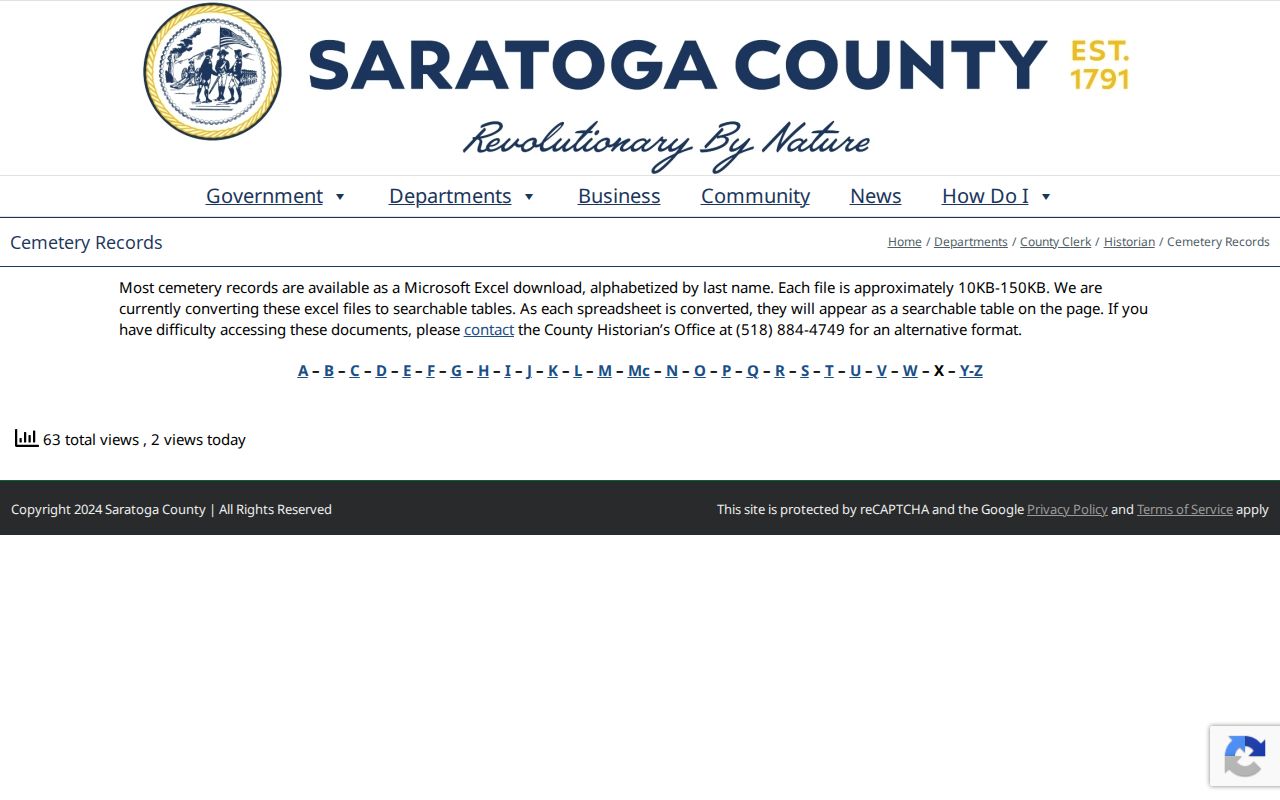
Cemetery records are an endpoint clue, not proof that a person occupied a specific Clifton Park address.
Saratoga County also offers a free Property Fraud Alert for a selected name in land and court filings. It can be useful after a deed-chain search to monitor new county filings, but an alert does not invalidate a filing and does not cover other counties.
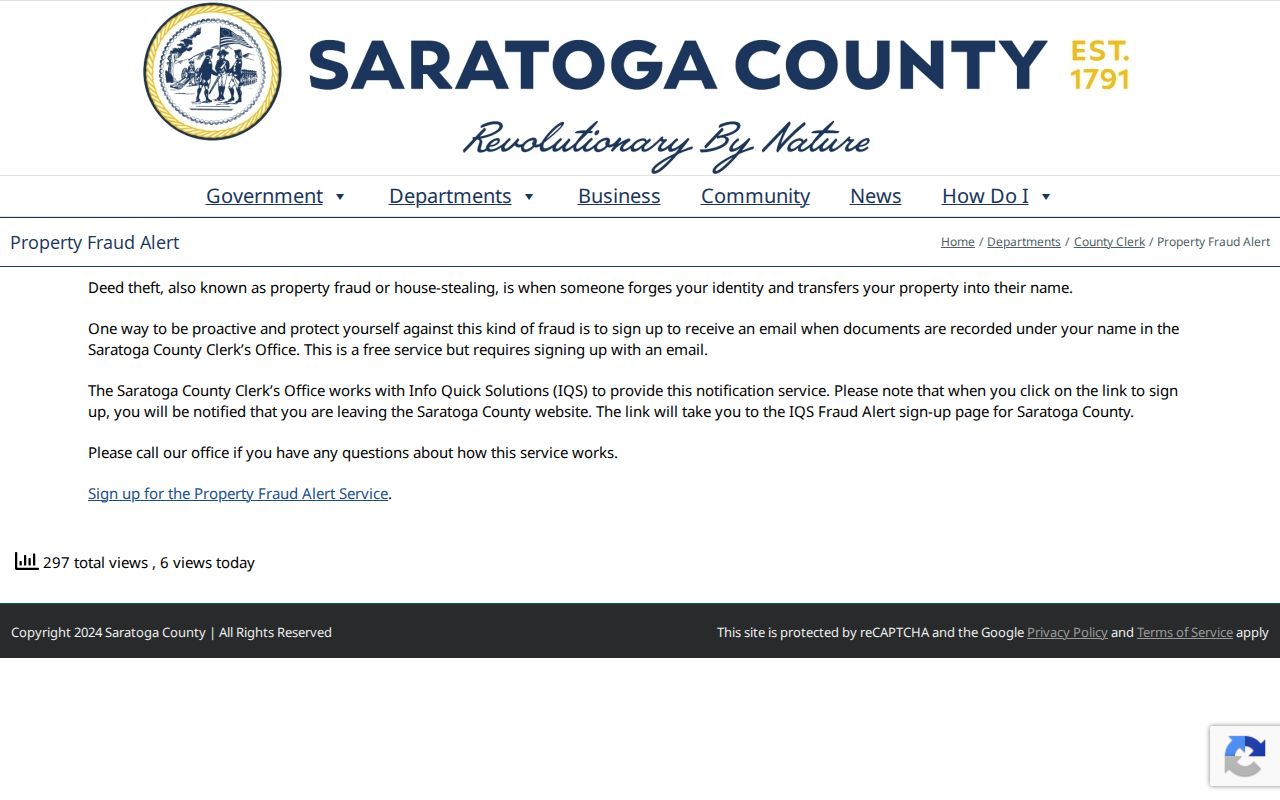
The alert is a current county filing monitor, separate from the historical evidence needed to establish a past household.
Lawful personal use. Previous-resident research in Clifton Park belongs to house history, family history, estate work, and personal curiosity. Do not use a historical trail to harass, stalk, or track a living person; New York law prohibits stalking and related harmful conduct.