
Clifton Park City Directory Collections
Clifton Park has strong local-history repositories in Saratoga County, New York, but the official material reviewed does not publish a verified publisher-and-year list for a town directory listing. That limit matters. A catalog record, shelf check, or reference response should establish the title, place covered, year, format, and whether it has a street section before a result is treated as a local listing. The most dependable first route is the library reference desk, followed by the County Historian and the Library of Congress catalog.
| Collection or lead | Published scope or years | Custodian | Access route |
|---|---|---|---|
| Town Collection and local-history materials | Exact Clifton Park city-directory runs were not located in official sources | Clifton Park-Halfmoon Public Library | Ask the Local History Room to check its inventory, catalog, and any shelf or microfilm listing |
| Saratoga County historical reference collections | A 1905 Saratoga Springs city-directory reference is documented; Clifton Park coverage remains unverified | Saratoga County Historian | Research appointment, Tuesday through Thursday |
| United States city and telephone directories | More than 1,200 places, primarily 1861 to 1960 | Library of Congress | Print, microfilm, microfiche, and digital holdings by request |
| Surname and vertical-file collections | No confirmed directory-year run published | Brookside Museum History Center | Research inquiry or visit by arrangement |
Request an exact place and year, not simply “Clifton Park directories.” A rural or suburban resident may be indexed under Saratoga Springs, Schenectady, Rexford, Vischer Ferry, or a county or telephone heading. The table is a route to inspect holdings, not a claim that every collection contains a Clifton Park entry.
Clifton Park Directory History Room
The Ed & Francine Rodger Local History Room is the most local starting point when the needed directory title is uncertain. Its Town Collection preserves photographs, letters, diaries, scrapbooks, Justice of the Peace material, history files, books, cemetery compilations, and local maps. Reference staff can help determine whether a town, county, telephone, or regional directory sits beside those materials. The room also points researchers to local digital exhibits and historic photographs.
The library’s pre-Shenendehowa material gives a separate way to test a family’s presence. It holds records and photographs from 22 small schools in Clifton Park, Halfmoon, Malta, and Round Lake. The schools were consolidated in 1950, and the associated district and Rodney Winans papers are mainly from 1910 to 1961. The collection is incomplete, so an absent name is not a negative result.
See the library’s local-history research overview before contacting staff about a specific directory title or family name.
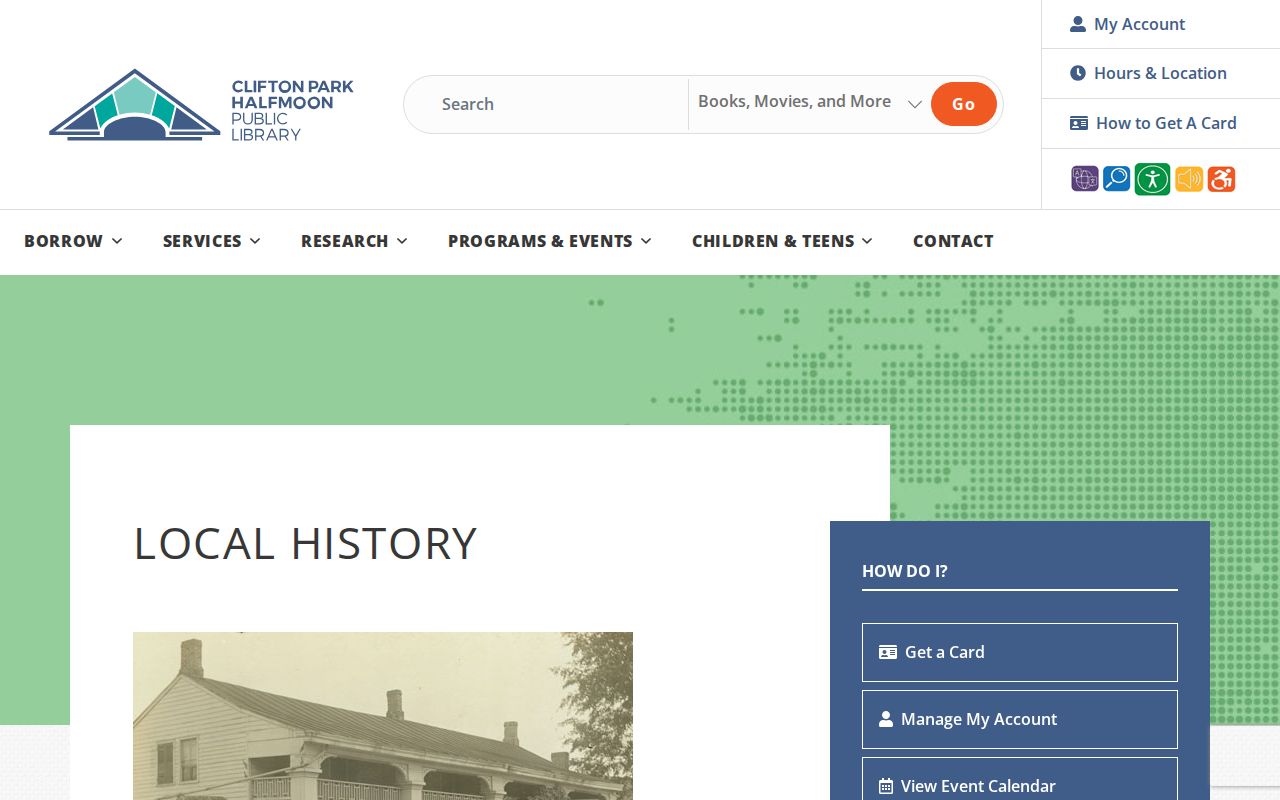
The Local History Room supplies the manuscript, map, school, and microfilm context needed when one volume alone is too thin.
Verify Clifton Park Directory Years
No official source reviewed supplied a continuous Clifton Park city-directory publisher list or year run. Do not assign a Polk title, a date span, or a reverse-directory section to Clifton Park until a catalog entry or volume confirms it. Ask the library whether a Saratoga Springs edition includes Clifton Park, Rexford, or Vischer Ferry; whether county rural directories or telephone books have a reverse section; and whether a volume is print, microfilm, or a licensed database image.
The same caution applies to gaps. Older directories were often gathered by door-to-door survey and issued irregularly. A person’s disappearance from one volume may mean the book omitted that locality, had a different naming convention, or did not publish that year. Compare the title page, geographic coverage, and abbreviation key before drawing a conclusion. Note: A missing directory entry does not prove that a Clifton Park resident moved.
Clifton Park Criss-Cross Directories
The Library of Congress directory collection is the national fallback when the local shelf cannot confirm a volume. It represents more than 1,200 cities, towns, and counties, primarily from 1861 to 1960. Formats include City Business, Telephone, Street Address, and Criss-Cross directories. Give staff the location and state, directory type, and exact year requested. The Library of Congress uses in-person paper slips in the Science & Business Reading Room, permits up to 40 requests per day, and encourages advance planning for bulk pulls.
A volume may list surnames alphabetically, while a street-address or criss-cross arrangement works from the address. Some volumes also include telephone information. Those are categories to inspect in a particular book, not confirmed Clifton Park features. Nearby-community coverage is especially important because Clifton Park developed as a town rather than a single historic city center.
The Library of Congress guide describes the formats and request process used to narrow a directory search.
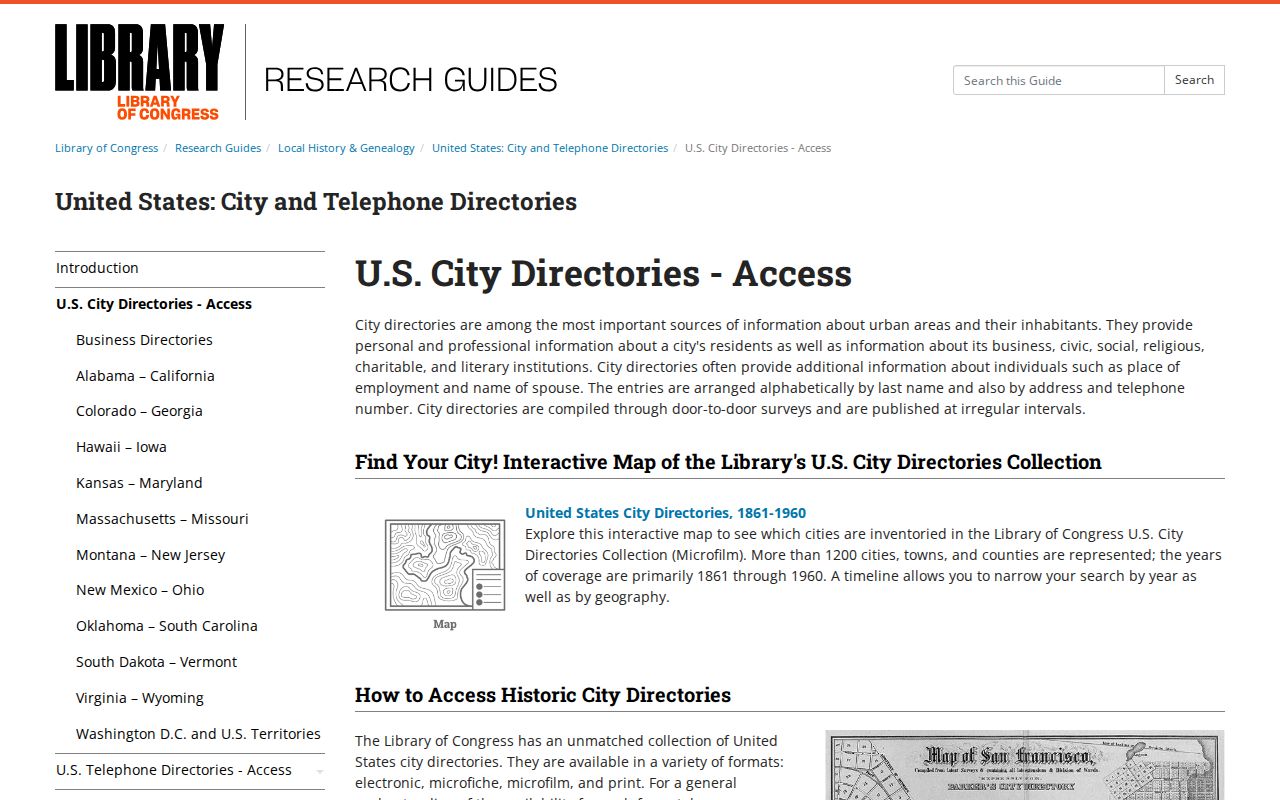
Use a confirmed regional title as a lead, then test its geographic coverage against the family’s road, hamlet, and census township.
Reading a Clifton Park City Directory
No authenticated Clifton Park sample entry was available in the official material reviewed. The field inventory below comes from the Library of Congress description and is a checklist for a volume in hand. It does not state that every local book has these fields, uses these abbreviations, or confirms a person lived in Clifton Park. Photograph the title page, page number, and key when a relevant entry is found.
| Name | Check the surname, given name, initials, and any alternate spelling. |
|---|---|
| Household clues | Look conditionally for a spouse name, “widow of” notation, room or boarder notation, or a status mark. |
| Work or affiliation | Some entries may show an occupation, employer, business, or civic or religious affiliation. |
| Address or phone | Check whether the particular volume gives a house number, street, telephone number, or a reverse-address reference. |
| Front matter | Read the local abbreviation key before interpreting letters such as owner, renter, moved, or student marks. |
- Criss-cross directory
- A directory arranged by street address rather than surname, when a volume includes that section.
- Householder index
- An index organized around a household name or address, if the publisher provided one.
- Abbreviation key
- The publisher’s explanation of shortened terms, usually in front matter; its meaning must be read from that volume.
Clifton Park Directory Census Pairs
Directory clues become stronger when paired with a dated household record. The library’s Saratoga County microfilm explicitly includes the 1800, 1855, 1865, 1875, 1892, 1905, 1915, and 1925 state-census years. Federal census material publicly available under the release rule reaches 1790 to 1950. The County Historian also holds federal and state census material, so its appointment route is a useful fallback when a library reader or database does not answer the question.
- Record the exact spelling, address wording, and year from a confirmed directory title.
- Find the nearest New York State or federal census and compare the whole household, not one name alone.
- Use the enumerator district, road, and town label when a modern Clifton Park postal label does not appear.
- Compare a map, cemetery record, or obituary before treating a gap as a move or death.
- Keep the page number and source format with each finding so a later reader can repeat the check.
The library’s genealogy and research resources include in-library Ancestry Library Edition, specified FamilySearch computers, HeritageQuest options, Gale News, and newspaper resources. Each source answers a different part of the household question.
Directory findings gain weight when the census, newspaper, or local-history database supplies the same family, road, or time period.
Clifton Park School Directory Gaps
Before modern subdivision addresses, local maps and institutions can provide the missing geography. The Local History Room holds copies of the 1856 Geil Map and 1866 Beers Atlas. The County Historian adds the 1875 Beers Map and the 1890 Lant & Silvernail Farmers Atlas, along with topographic and survey maps. These sources can place roads, watercourses, farms, and communities before a later address or postal name took hold.
The Pre-Shenendehowa Schools Collection is a useful Clifton Park story within that gap. Its material from the 22 small schools is mainly 1910 to 1961 and records a system consolidated in 1950. A school image, district paper, church record, or map may connect a surname to a place when no local volume has been confirmed. The result is still evidence to compare, not proof of an address.
Clifton Park Directory Surname Files
The Saratoga County Historian offers appointment-based research Tuesday through Thursday, 9 a.m. to 4 p.m. Its collections include the Henry C. Ritchie Saratoga County Families Collection, surname files, family Bibles, town files, church and cemetery material, voter lists from 1912 to 1975, and municipal assessment records from 1889 to 1914. Those records can establish a local research path even when a directory title is unresolved.
Brookside Museum’s Irena Wooton Research Room provides a second route with surname and vertical files, a research library, archival collections, and Heritage Hunters books. Visits are by arrangement, fragile material may have reproduction limits, and staff accepts research inquiries. Its PastPerfect catalog can help identify collection material before a visit.
The Brookside genealogy desk describes the inquiry and research-service route for its historical collections.
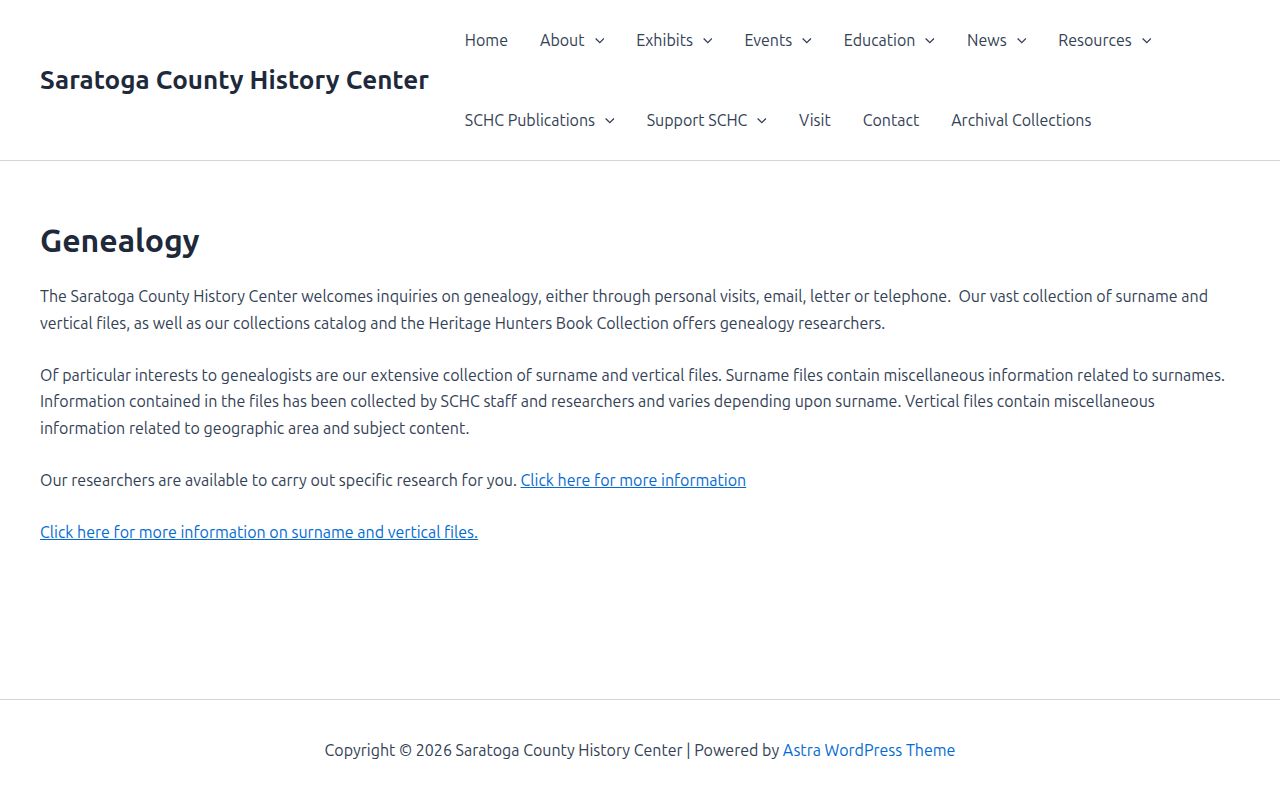
Brookside’s files can supply a surname, church, map, or local-history lead to take back to a confirmed directory or census source.
Trace Clifton Park City Directories
For family history, treat each volume as one dated observation. Start with the first confirmed appearance, then follow the same name, address wording, and associated people through later titles only after their coverage is verified. Search married and maiden names, initials, phonetic variants, and local hamlet labels. A Clifton Park resident may be absent from a Saratoga Springs volume while appearing in a county map, census, school, church, assessment, or telephone source.
Close a trail with records that explain a change. The library’s clipping files and news resources, the County Historian’s surname and cemetery material, and county cemetery spreadsheets can help test a death, move, or family connection. Church material can predate civil records, and Baptist church records appear in the library microfilm listing. An obituary or cemetery match needs the right town, cemetery, date, and family context before it is attributed to the same person.
Note: Keep a research log that separates confirmed volume facts from unverified Clifton Park directory possibilities.